
Searching Lane County Civil Dockets
Kansas runs one statewide public tool for this work: Kansas CaseSearch. It covers qualifying civil case records from Lane County District Court. The old District Court Public Access Portal closed in 2025, and CaseSearch replaced it. To get in, Smart Search asks for a record number or a name. Registration and a reCAPTCHA step come with it. Once inside, set Location to Lane and narrow results by case type, status, file-date range, or judicial officer.
The cleanest route is a full case number. Fall back to a party-name search only when the number is unknown. Then check the party roles and case category before trusting a lookalike result. Two dead ends trip people up. Kansas eFlex serves authorized filers, not the public civil docket viewer. The Lane County Clerk's county administration and elections office holds no civil-court files. Those stay with the Lane County District Court Clerk.
- Open CaseSearch and complete its current terms, account, and verification steps.
- Enter the full number, or use an accurate party or business name and set Location to Lane.
- Confirm whether the case is a regular action, limited action, domestic matter, probate case, or another category.
- Read the events index for filing, service, answers, motions, settings, judgment, and post-judgment events.
- Open available document links, or ask the clerk for the specific filing or certified copy that is needed.
Lane Civil Filing Feed
The Kansas Civil Filings page went live in 2025. It can surface newly submitted civil documents before court staff review or accept them. Under Supreme Court Rule 23(c), an unsealed submission normally stays visible for three days unless rejected. The annual report says so. So treat the feed as a short-lived lead. It is no lasting Lane County civil docket archive.
Seeing a document there proves nothing about acceptance or final status. Confirm the accepted record through CaseSearch or the Lane County District Court Clerk. A submission can vanish for several reasons. Rejection, sealing, the brief publication window, or ordinary processing all qualify. Disappearance alone never tells you which. Note: When you need an accurate case status, cite the accepted case record. Do not cite a transient new-filing screen.
Inside a Lane County Civil Docket
Every civil docket stacks two layers. The header identifies the case. It lists Lane County, case number, filing date, category, status, judicial officer, parties, and attorneys. Below it sits the events index. That index logs pleadings, service, answers, motions, conferences, hearings, orders, disposition, and any later enforcement or appeal activity. One caution applies. A public event line does not guarantee a public link to the filing itself.
| Case number | The exact identifier. Older Lane cases may use 2022-CV-000001; newer Odyssey cases add a county prefix that should not be guessed. |
|---|---|
| Parties and roles | Plaintiff or petitioner, defendant or respondent, attorneys, and public service or answer status. |
| Pleadings | Petition or complaint, summons, answer, amended pleading, counterclaim, and response entries. |
| Motions and settings | Motion title, notice, response, hearing, pretrial conference, mediation, discovery date, or trial setting. |
| Disposition | Dismissal, consent or settlement entry, judgment, summary judgment, trial result, or uncontested disposition. |
| Access flags | Sealed case, family-document limit, kiosk-only conversion, redaction, or missing web link. |
The docket is not the document. A signed judgment, petition, or transcript stands as its own record. The docket tells you an event happened; the filed paper supplies the terms. When formal proof matters, request that exact record. Do not trust a printout of the case summary.
Lane Civil Docket Volume
Lane County is a small civil docket by state standards. The official Civil Case Filings table counts 60 Lane civil filings for the fiscal year ending June 30, 2025. That figure counts cases rather than people. The breakdown: four regular actions, 44 limited actions, and 12 domestic-relations filings. Within the limited actions, contract claims account for 42. The regular actions split into three real-property filings and one other filing. On the domestic side sit nine marital-status matters, one other matter, and two protection-from-abuse filings.
A separate disposition table tells a different story. Five are regular-action. It also shows 42 limited-action and 14 domestic-relations dispositions, for 61 results. Those 61 results do not clash with the 60 new filings. A disposition can close a case filed in an earlier period. A new filing may still sit open after year-end. Without the detailed disposition columns, the totals cannot support any settlement-rate claim.
Civil Case Types on the Docket
One district-clerk structure holds several civil paths in Lane County District Court. The portal category matters, because it signals which events appear and which access limits attach. Regular actions cover contract, tort, property, and other general civil claims. Limited actions run on Kansas Chapter 61 procedure. Domestic-relations matters form a third category. Public access to those cases and their documents runs narrower.
- Regular actions, including contract, real-property, tort, and other general civil matters.
- Limited actions, including the contract-heavy category reflected in Lane's FY2025 filing row.
- Domestic relations, including marital-status and related family matters subject to Rule 22 limits.
- Probate and guardianship categories, whose public web access can differ from ordinary civil cases.
- Post-judgment and appeal events that continue after an initial order or judgment.
A category label never tells the whole claim. Read the petition when it is lawfully available. Some categories never appear in the portal at all, including protection orders, adoption, and child-in-need-of-care cases. Even where case information is visible, family documents can stay restricted.
Lane Civil Docket or File
The events index and the court file answer separate questions. Use the index to locate a case. It also shows the status, and when a motion or judgment was entered. The filed record holds the actual petition, service paper, answer, motion, affidavit, order, or judgment. CaseSearch may supply both layers for newer public material. Converted documents, though, may exist only at the courthouse kiosk.
| Question | Public docket layer | Filed-record layer |
|---|---|---|
| What identifies the case? | Number, category, parties, judge, status | Caption and filed document |
| What happened? | Dated event and setting lines | Motion, order, judgment, or transcript text |
| Where might it appear? | CaseSearch and public terminal | Web link, terminal, or clerk request depending on access |
| What supports formal proof? | Search lead only | Plain or certified copy from the clerk |
When a case number is public but an order is not linked, ask for the document by title and date. A broad request for an entire case history draws less precision. The Kansas Judicial Branch KORA request form covers the court, requester contact, delivery method, record description, commercial-use certification, signature, and date.
Lane Civil Docket Settings
A Lane County civil docket may show many kinds of settings. Motion hearings and pretrial conferences appear, along with scheduling conferences, mediation, trial dates, and post-judgment matters. Local Rule 301 sets the rules for motions that request oral argument. Notice and proof of service are required. You coordinate through the administrative assistant or county magistrate judge. Rule 302 covers written continuance requests and the orders that follow. When a hearing moves, Rule 304 makes counsel notify clients and subpoenaed witnesses.
The 24th Judicial District rules also handle mandatory mediation, pretrial conferences, and civil case management. Treat them as search leads. Not every case gets every event. So read the actual Lane events index and the scheduling order. Interpreter requests work differently. Under local Rule 305, ask at least five business days before the hearing or trial.
The statewide self-help calendar covers the next seven days. It can filter by county or judge. It may list the hearing time, case type, and presiding judge. Need a date beyond that window? Review the case events and contact the clerk. The dedicated Lane County court dates resource explains resets and setting fields in more depth.
Lane Family Docket Limits
Family docket access in Lane County is not a simple public-or-sealed split. Rule 22 keeps some documents off the public web portal. Those cover child custody, visitation, support, dissolution, and parentage. Adoption, child-in-need-of-care, protection-order, juvenile, and several other categories are excluded too. Case information can be public while its documents are not.
Converted domestic, juvenile, or guardianship documents may be kiosk-only. That happens when the access rule permits terminal viewing. Other categories stay nonpublic at both the portal and the terminal. A blank web search does not mean a Lane County civil case is sealed. Check the case number format, court, case type, and migration date. Separate case information from documents. The clerk can point to a lawful request path or state the authority for denial. But the clerk cannot override a seal.
Public case, restricted document: A visible party, case number, or event line does not make custody papers, a dissolution filing, or another Rule 22 document public online.
Civil Docket Access Rules
Lane County civil docket access starts online but does not stop there. Rule 22 requires a public terminal at each district court. The Lane County District Court terminal and counter sit at 144 S. Lane in Dighton. Published hours are 8:00 a.m. to 5:00 p.m. on weekdays. The counter closes from noon to 1:00 p.m. Before you drive over, call 620-397-2805. Confirm current access, and ask whether a specific public converted document is available there.
Key access rules:
Kansas Supreme Court Rule 22 defines portal, terminal, and inaccessible civil case and document categories.
K.S.A. 45-218 requires prompt handling, allows lawful fees, and sets a third-business-day response point.
K.S.A. 45-221 supplies the exemption framework and supports separating open material from closed material where applicable.
You can also request records in writing. Mail written requests to Lane County District Court, P.O. Box 188, Dighton, KS 67839, or fax them to 620-397-5526 under current clerk instructions. Use the official form. Identify the case number, the filing, the date range, your delivery method, and the format you want. The clerk posts no local civil fee schedule. So ask for the current copy or certification estimate. Keep one limit in mind: the statutory response point does not guarantee document production within three business days.
Lane Civil Calendar Support
The Kansas Judicial Branch self-help center supplies forms and process information along with the statewide hearings calendar. Its landing screen is a handy checkpoint whenever a Lane County civil docket raises a deadline or hearing question. It is not case-specific legal advice, and it does not replace the clerk's current setting record.
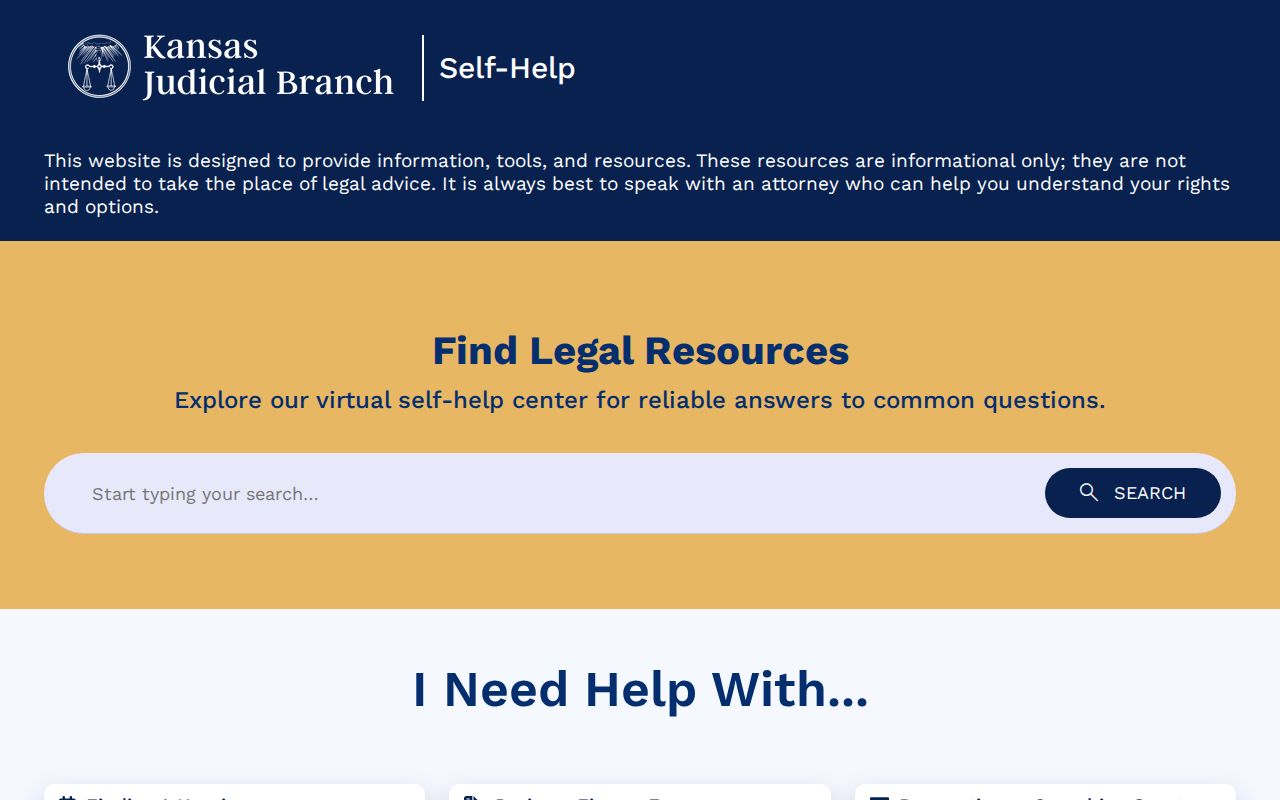
The self-help portal links rural Lane users to statewide court resources. Lane County posts no separate daily civil calendar. Confirm any displayed setting against the events index and the court notice.
For copies, use the 24th District email-image form. It generally covers previously imaged documents from January 1, 2008, forward. Many requests are produced within three business days. Confidential material goes only to eligible recipients. So ask the Lane clerk whether a public request fits that route. Transcripts are different. They follow Appendix 3B, require a judge's signature, and are produced at requester expense.
Note: The self-help calendar is only a short date view. The Lane civil docket remains the case's chronological record.